
What a London Asbestos Survey Report Should Contain and How to Spot a Bad One | Asbestos Survey London
An authentic asbestos survey London report should explain what was evaluated, where asbestos containing materials (ACMs) were found or presumed to be present, which areas could not be inspected and what action may be required. Landlords and contractors arranging an asbestos survey in London service for property owners. Such details are essential for understanding the situation of the building and making proactive decisions prior maintenance or construction work starts.
The Health and Safety Executive (HSE) sets out the expected structure and content of asbestos survey reports in its guidance. A report that lacks clear findings, reliable sample results or an accurate account of its limitations may leave important questions unanswered. Knowing what a good report should contain helps you identify potential problems and resolve them before they affect your project.
What Should an Asbestos Survey Report Include?
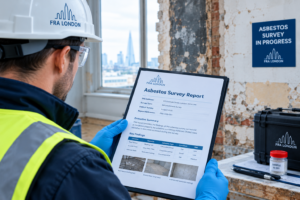
A good report should identify the property and survey scope, explain the inspection methodology, present the findings, record any limitations and provide information that supports appropriate asbestos management. The precise content will depend on the building, the type of survey and the work being planned.
1. Property Details, Survey Scope and Surveyor Information
The report should clearly recognize the premises such as its full address and a sufficient description of the building. It should record the client or commissioning party, the surveyor’s identity, the surveying organization and the dates of the inspection and report. A report version number, references or revision status can also help maintain an accurate record.
The survey’s purpose and scope should be equally clear. The report should explain which areas were inspected, which were excluded and why, the type of survey undertaken, and whether the inspection was suitable for its intended use.
Surveyor competence matters, too. Relevant training, qualifications, practical experience and quality assurance arrangements can help demonstrate competence. A qualification such as BOHS P402 may be relevant, but a certificate alone does not establish that a surveyor is competent for every building or survey type.
Check for this warning sign: If the report does not explain the survey type, inspection boundaries or purpose, ask the provider to confirm whether it covers your actual requirements.
2. The Correct Type of Asbestos Survey
The report should distinguish between a management survey and a refurbishment or demolition survey.
A management survey is intended to locate, as far as reasonably practicable, ACMs that could be disturbed during normal occupation and routine maintenance. Its findings support the ongoing management of asbestos within the premises.
A refurbishment or demolition survey in London is required before relevant refurbishment or demolition work begins. It involves an intrusive inspection of the areas affected by the planned work to locate ACMs that could be disturbed. The necessary access and level of intrusion depend on the project and the areas being investigated.
These surveys are not interchangeable. A management survey should not automatically be treated as sufficient for a project involving structural alterations, removal of building components or work inside concealed spaces.
3. Clear Findings and Accurate ACM Locations
The survey results are the core of the report. Every identified or presumed ACM should be described clearly enough for a property manager, maintenance worker or contractor to locate it on site.
Relevant information should include the material’s location, product type, characteristics, approximate extent or quantity and condition. Depending on the building, useful descriptions may identify a particular room, ceiling void, service riser, plant room or building component.
For example, a statement such as “asbestos present in the plant room” is of limited practical value. A report should provide a more precise description of the material and where it was found.
The findings should also distinguish between:
Confirmed ACMs: Materials in which asbestos has been identified through appropriate analysis.
Presumed ACMs: Materials treated as containing asbestos because they have not been adequately confirmed as asbestos-free.
Materials with negative results: Materials in which asbestos was not detected in the samples analysed, subject to the scope and limitations of the investigation.
A competent surveyor may presume a material contains asbestos where sampling is inappropriate or uncertainty remains. The report should make that status clear rather than presenting assumptions as confirmed laboratory findings.
4. Laboratory Results and Sample References
Where samples have been collected, the report should include the relevant analysis results and make it possible to match each result to the correct material and location. Sample reference numbers should be consistent across the findings, sample schedule and laboratory documentation.
In Great Britain, asbestos samples should be analysed by a suitably competent laboratory, with relevant UKAS accreditation providing an important means of demonstrating laboratory competence. The HSE offers guidance on asbestos surveyors, analysts and related competence.
Check for this warning sign: If sample references cannot be traced to the materials described in the report, or the laboratory findings are missing or unclear, ask for clarification before relying on the results.
5. Material Condition and Risk Information
A report should record the condition of identified or presumed ACMs and provide material assessment findings where appropriate.
A material assessment considers factors such as the product type, asbestos type, surface treatment and extent of damage. Its purpose is to assess the material’s potential to release fibres if disturbed and to indicate its relative hazard.
However, a material assessment score is not a complete assessment of the risk in the building. The dutyholder’s priority assessment considers other relevant factors, including how the area is used, the likelihood of disturbance and the activities taking place nearby. These considerations help inform decisions about which materials need attention first.
The materials that are damaged, deteriorated or otherwise concerning should be clearly highlighted. The asbestos survey provides enough information to facilitate reliable management decisions, instead simply listing materials and scores without explaining their importance.
6. Survey Limitations and Inaccessible Areas
A good survey should not be assumed to cover areas that were never evaluated. An effective report must spot significant access restrictions, exclusions, assumptions and remaining uncertainties.
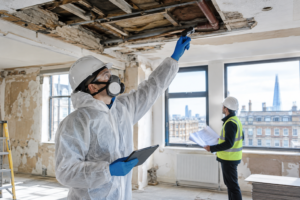
Examples include locked rooms, inaccessible ceiling voids, concealed structural elements or areas where intrusive inspection could not be completed. The report should explain why access was restricted and how this may affect the findings.
The distinction is important: an uninspected area cannot automatically be treated as asbestos-free. Depending on the planned work and the circumstances, further investigation may be needed before contractors proceed.
The HSE explains the importance of defining the scope and arranging an appropriate inspection in its guidance on arranging an asbestos survey.
What Makes an Asbestos Survey Report Poor Quality?
A lengthy report is not necessarily a reliable one. The important question is whether the findings are accurate, clear and suitable for the intended purpose.
Watch for these warning signs:
Unclear scope: The survey type and areas covered are not properly explained.
Vague findings: Materials are listed without precise locations or useful descriptions.
Missing evidence: Laboratory results are absent or cannot be matched to sample references.
Unexplained exclusions: Areas remain uninspected without clear details or follow-up advice.
Inconsistent records: Plans, photographs and written findings do not match.
Unclear conclusions: The report does not explain what action may be required.
Is an Asbestos Survey Report the Same as an Asbestos Register?
No, An asbestos survey report records the findings of an inspection, while an asbestos register is the working record of known and presumed ACMs in a building. An asbestos management plan sets out how those risks will be controlled.
The survey report should provide information that can be used to create or update the register. The register should record the locations and types of ACMs, their condition, inspection information and relevant risk assessment findings. It should also account for areas that could not be inspected and where asbestos may need to be presumed present.
Under the Control of Asbestos Regulations 2012, the duty to manage applies to relevant non-domestic premises and the common parts of multi-occupancy domestic buildings. Where the duty applies, the responsible person must maintain appropriate records, assess risks and put a management plan into action.
What Should You Do After Receiving the Report?
Receiving an asbestos survey report is not the end of the process. The findings need to be reviewed and used appropriately.
- Check the scope: Confirm that the survey covers the building areas and activities relevant to your needs.
- Review the findings: Identify known and presumed ACMs, their locations and their condition.
- Resolve limitations: Establish whether further inspection is needed in inaccessible or uninspected areas.
- Update the register and management plan: Where the duty to manage applies, use the findings to maintain current records and plan appropriate controls.
- Share relevant information: Make sure contractors and maintenance workers receive the information they need before work that could disturb ACMs begins.
- Arrange further action where necessary: Depending on the findings, this may involve monitoring, protecting or repairing materials, further investigation or appropriate removal before planned work.
Choosing an Asbestos Survey Provider in London
When arranging a survey, explain whether you need information for routine property management, refurbishment or demolition. Share existing reports and building plans where available, and describe the areas that contractors intend to alter. This helps the surveyor establish an appropriate scope and produce findings that are useful for the decisions ahead.
The HSE strongly recommends using competent asbestos surveying organisations and provides guidance on checking qualifications, experience and accreditation. Although surveyor accreditation is not itself a universal legal requirement, competence is essential. Laboratory analysis must meet the applicable accreditation requirements.
FRA London provides asbestos survey services across London, including management and refurbishment surveys. Its service information states that samples are analysed by an independent UKAS-accredited laboratory. To discuss your property and the appropriate survey scope, visit the FRA London asbestos survey service.